The Platform
One operating system for
consequential work.
Coheria is an AI Operating System: a layered platform that takes responsibility for the whole stack of running a company with AI — from the silicon up to the boardroom — for many organizations on one shared, accountable foundation. The conviction underneath every floor: no single AI model is trusted to do consequential work alone.
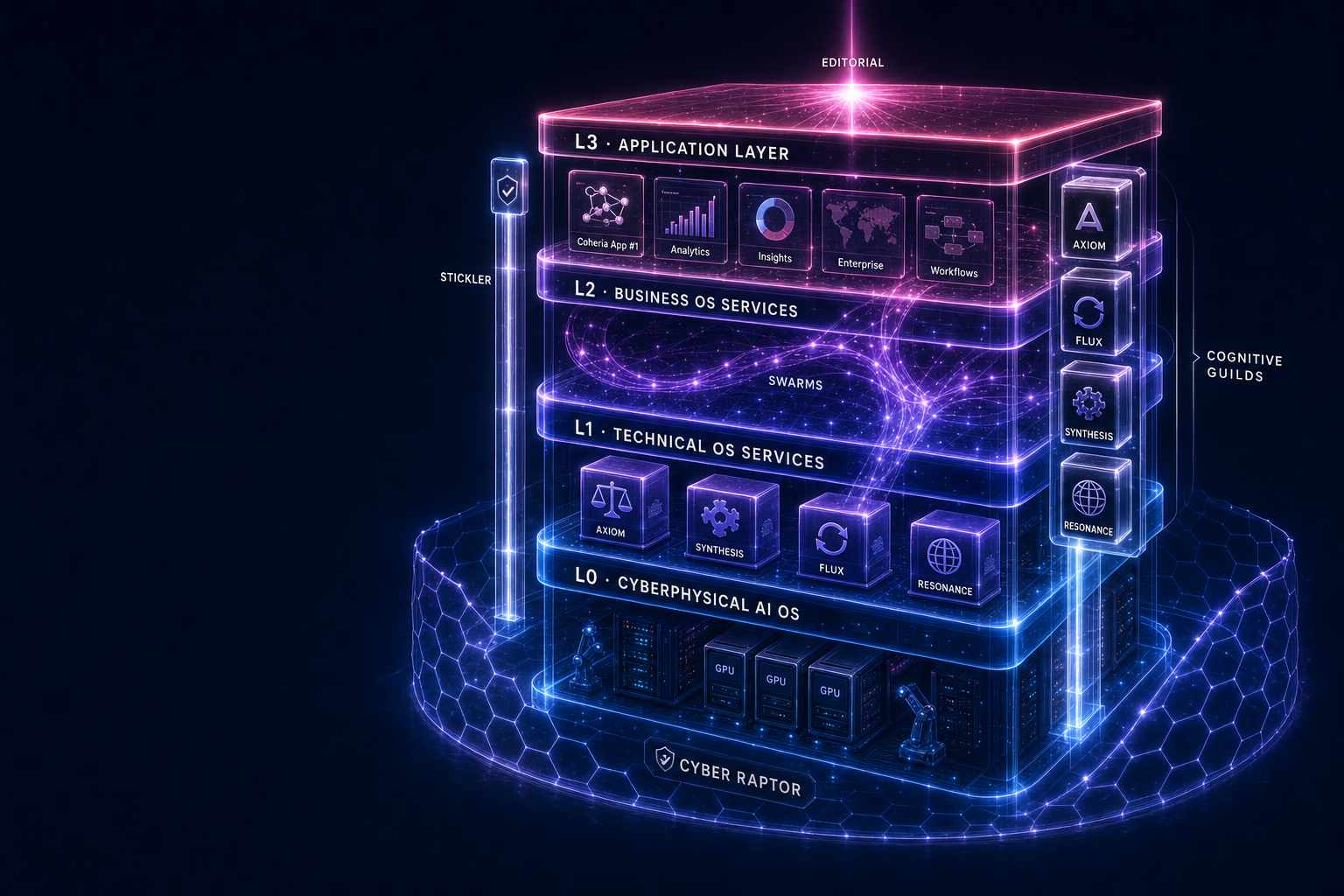
The architecture
Four floors. One foundation.
Read it bottom-up, the way it is built — each floor stands on the one beneath it. Together they turn a messy world of clouds, models and tools into a single, governed system a company can actually run on.
Company Applications
Where companies liveEach company is an application assembled from the services below it — Kindred, Inspire, and Praxis are the first three. Coheria runs its own company here too.
Business AI Services
The functions a company recognizesAccounting, legal, marketing, sales, operations, HR, research — run as living services that always work from the latest information and can commission technical work as they go.
Technical AI Services
The capability factoryIntegration, engineering, programming, data, security and more — the reusable services everything above is built from, kept current by a continuous Update Service.
Cyberphysical AI OS
The hypervisor of the physical worldManages the clouds, hardware, memory and networks, watches every provider for change, and secures every message between locations with Cyber Raptor.
The Coheria Continuum
The platform that remembers the work.
Beneath the four floors sits the Coheria Continuum, the platform's persistent world-model layer. It is not a data cache, and it is not a fifth floor. It accumulates a continuously updated model of each customer's specific operating world, and Kindred, Inspire and Praxis all read from it and write to it. Each customer's memory is structurally isolated.
Your operating world, modeled
The Continuum learns the unwritten workflows, the communication styles, and the decision patterns unique to that person or business, alongside a catalog of verified task solutions. It keeps every verified solution, so the platform never solves the same problem twice.
One memory, three products
Every transaction leaves the system slightly better at your work, lowering the cost of serving you while raising the quality of what you receive. The improvement is generated by operation rather than an engineering release, and it accrues to every product on the platform at once.
Impossible to import
A competitor can duplicate features, license similar base models, even reproduce the orchestration pattern. It cannot import years of your corrections, preferences, and proven solutions, because that content is created only by running, and only inside your sealed vault.
The end state is a world of worlds: many bounded worlds sharing one intelligence, never sharing tenant-specific data.
Runs through every floor
The threads that make it accountable.
A few capabilities run vertically through all four layers rather than living on any one of them. They are what turn raw model capability into a system you can trust with real work.
Cognitive Guilds
AXIOM reasons by constraint, FLUX by exchange and value, SYNTHESIS by building, RESONANCE by modeling people and markets. Four ways of thinking that work on every floor.
Swarms
Dynamic crews pulled from the Guilds and a floor’s services to solve one problem together as equals — then disband when the work is done.
The Stickler
Coheria’s accountability inspector, present on every floor in a form tuned to its work. It refuses to let work ship when a required step was quietly skipped.
Editorial Membrane
The only surface a human ever touches. Every request a person makes enters through it; everything the platform says passes back through it.
The Adaptive Execution Loop governs it all. No layer is static at runtime — the Guilds and the Stickler run as governed workflows driven by signed, versioned policy objects, so what the system does next, and why, can be read, audited and versioned without rewriting code.
The Accountability Map
Accountability that can say no.
Recording what happened is the easy part. Underneath the inspectors, every consequential action leaves a decision record in an append-only, tamper-evident audit substrate, and that substrate has a name. The Accountability Map is what a customer actually receives: not a promise that the work was checked, but the checks themselves. Every engagement ships with it.
One map, every floor
The Accountability Map is a structured audit system: one schema, one capture loop, one ledger, exercised on every floor of the architecture. It is an audit system, not a log table.
Evidence in the box
Every answer ships with its evidence: the teams, the research, the pushback, and the test results behind it. You audit the work instead of trusting it.
One function, four forms
The Stickler is a single auditing function executed in four specialized contexts, because a generalist audit misses domain nuance. Checking a database placement, a financial close, and a customer-facing paragraph demand different standards and different consequences.
Copilots log. The Stickler refuses, and that difference is the whole governance story.
The Independent Safety Subsystem
Independent by construction, not by promise.
The Independent Safety Subsystem is an upstream, isolated barrier that enforces hard content, legal and disclosure policies before any output reaches the presentation layer. It runs in dedicated, firewalled namespaces, and no business service can write to an external channel or a human being without clearing it. There is no exception path.
Stage one: enforcement
Every generated output enters a two-stage egress pathway. Objective policy enforcement, legal compliance, and disclosure injection are applied first, inside the network- and infrastructure-isolated subsystem.
Stage two: style
The Layer 3 inspector sits at editorial ingress and refuses any payload that lacks a valid cryptographic safety-pass stamp. What clears enters the Editorial Membrane, which handles tone, style harmonization, and brand personalization.
Separate by construction
The subsystem runs in dedicated, namespace-isolated environments with its own repositories, pipelines, registries, and operational teams. Its independence does not depend on anyone's discipline. The separation is structural rather than procedural.
No shared training loop
Core model operations has no ownership of, and no access to, safety training data, gradients, checkpoints, or policy-model updates. The subsystem runs its own isolated learning loop, with differential-privacy processing that prevents safety-derived feedback from leaking back into core training.
Four non-overlapping planes: the Safety Subsystem guards what content leaves the platform, the Stickler guards the process, Cyber Raptor guards against external adversaries and code-level compromise, and the Editorial Membrane handles style only.
Security & the Real-Time Blockchain
Wrapped in Cyber Raptor. Sealed on-chain.
The whole structure sits inside Cyber Raptor — the security-and-utilities envelope that handles identity, quantum-resilient channels and signed policy. Downstream of it, the Real-Time Blockchain records every execution identity, policy version and multi-model verdict as tamper-evident evidence.
See security & trustOne engine, three doors
The same platform, shaped to who you are.
On the top floor, every customer appears as their own application — private data, private goals — served by everything below. Three of those applications are available today.
One foundation.
Every kind of work.
From a household to an enterprise — the same accountable engine, with evidence for every decision.